

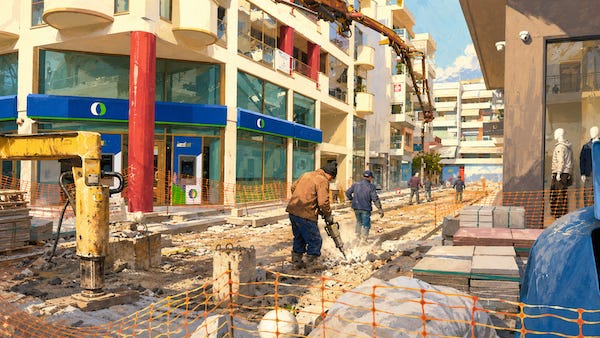
GRRRRRRRRRR
You hear it everywhere.
At daybreak.
At lunchtime.
At the exact moment the sun is saying goodnight and you are thinking, foolishly, that perhaps the day is over.
No.
GRRRRRRRRRR.
The national instrument has begun.
If you had just landed in Greece from outer space, you might think you were hearing an orchestra warming up.
A strange orchestra, yes.
An orchestra made entirely of angry metal birds attacking the sidewalk.
But still. An orchestra.
And you, being an alien, would not know any better.
You would turn to your alien wife and say, “How beautiful. Is this traditional music?”
And your alien wife would say, “I think they are removing a balcony.”
Because in Greece, the jackhammer is not just a tool.
It is a way of life.
It is the sound of progress, repair, regret, renovation, correction, and somebody realizing the pipe was actually on the other side.
Why is the jackhammer the go-to tool in Greece?
Because everything in Greece is made of cement.
Not some things.
Everything.
Streets? Cement.
Buildings? Cement.
Balconies? Cement.
Stairs? Cement.
Walls? Cement.
Dreams? Probably reinforced cement with rebar.
Greece has enough cement to build a solid foundation under the entire United States of America, with enough left over for a small island, three apartment buildings, and a suspicious little wall around someone’s cousin’s olive grove.
A couple of months ago, they started digging up a corner lot near us.
Let’s be careful with the word “lot.”
In America, a lot means half of Athens.
In Kalamata, a lot means a box.
Maybe ten by ten.
Maybe large enough for one building, two balconies, and three families arguing about parking forever.
They dug down twenty or thirty feet.
Then they built the foundation.
Then they closed it up and poured more cement on top.
Karen looked at it and said, “They’re building a bunker.”
She was not wrong.
Under the ground floor will be the basement.
Το υπόγειο (ipogio).
Maybe for parking.
Maybe for storage.
Maybe for the one tiny car that can enter only if everyone inside holds their breath and folds in the mirrors.
Above that, they will build three or four more floors.
All cement.
Then more cement.
Then bricks.
Then more cement.
Then tile.
Then someone will come back two weeks later and break part of it again because a pipe, wire, drain, cable, mystery tube, or cousin named Vangelis needs access.
This is where the jackhammer returns.
GRRRRRRRRRR.
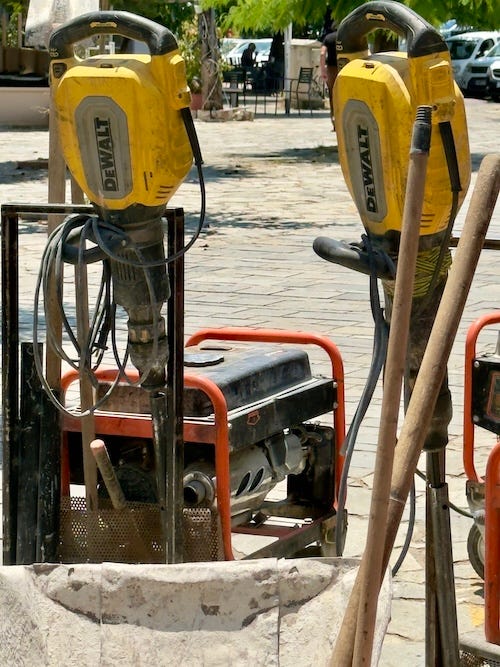
In America, interior walls are often metal framing and drywall.
Γυψοσανίδες (gipsosanides).
Fast. Light. Flexible. Easy to change.
In Greece?
Oh no no no.
That is not a wall.
That is a suggestion.
That is a theater set.
That is something you put in a building if you want your neighbors to think you have financial problems.
One day I was looking at a new apartment and talking to the head of construction.
I asked him, very innocently, “What about using γυψοσανίδες for the interior walls? Less expensive. Faster. Lighter. Easier if someone wants to change the space later.”
He looked at me with pity.
The way Greeks look at you when you have said something technically reasonable but culturally insane.
“No, no, no,” he said. “If I don’t use bricks, I won’t sell the apartments.”
Τούβλα (touvla).
Bricks.
Solid.
Heavy.
Serious.
Greek.
The customer wants to knock on the wall and hear destiny.
Not hollow.
Not flexible.
Not modern.
Destiny.
Never mind that Los Angeles skyscrapers survive earthquakes with steel, glass, and drywall.
What do the Californians know?
They don’t even put oregano on fries.
In Greece, a proper building must feel like it could survive an Ottoman siege, a German occupation, three inheritance disputes, two earthquakes, and an uncle with opinions.
So we build with cement.
We repair with cement.
We patch cement with more cement.
Then we dig it up.
Then we inspect it.
Then we close it again.
Then someone remembers something.
Then we open it again.
As I wrote before, Greece has a national construction method called:
Build it.
Rip it apart.
Do it again.
This applies to streets, walls, sidewalks, permits, family arguments, and possibly democracy.
And for this sacred cycle, one tool rises above all others.
Not the hammer.
Not the drill.
Not the shovel.
The jackhammer.
The king of tools.
The alarm clock of summer.
The soundtrack of renovation.
The voice of Greek civilization saying:
“We are almost finished.”
Which means, of course:
“We have just begun.”
GRRRRRRRRRR.
Siga, siga 💙
Nick in Kalamata
Discussion
Pull up a chair. Add a memory, a correction, a laugh, or something the story brought to mind.
No comments yet. We have been waiting for you...