

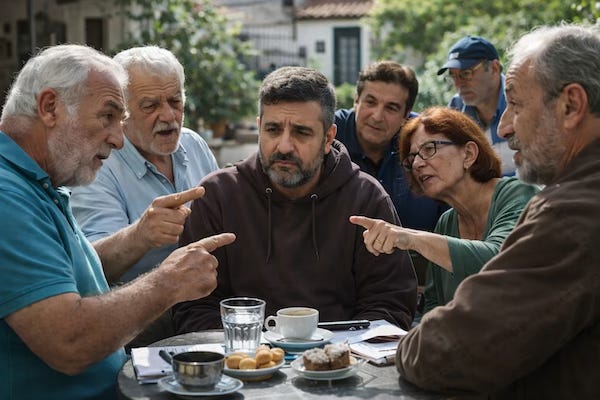
In Greece, advice is never in short supply. Professional boundaries, on the other hand, are more of a suggestion.
One of the great comforts of living in Greece is that you are never alone with your problems.
One of the great dangers is exactly the same thing.
Mention the smallest issue in passing—just casually, just while the coffee arrives—and suddenly you have triggered a full public consultation.
You say your shoulder hurts.
Before you can rotate it once for demonstration purposes, one person has diagnosed it, another has dismissed that diagnosis, a third has recommended magnesium, and a fourth is already calling a cousin in Patras who had “the exact same thing” after falling off a ladder in 1998.
You mention a tax question.
Big mistake.
Now the table becomes a symposium. Someone’s brother-in-law knows an accountant. Someone else says accountants are useless unless they are old enough to remember PASOK in its original form. A third insists you should wait until after Easter. A fourth says doing that would be a catastrophe, despite never having filed anything more complicated than a utility bill.
And then, as always, comes the most powerful credential in Greece:
“I know a guy.”
This is never said casually.
It is said with the authority of a ministerial appointment.
The guy may be a surgeon, a plumber, an electrician, a mechanic, a notary, or simply a man named Giorgos who “knows how these things are done.”
In Greece, that last qualification may be the strongest of all.
Because expertise here is not confined to the person who studied the subject. It radiates outward. It spreads through family, observation, hearsay, one unforgettable incident in 2003, and the fact that somebody’s cousin went through something vaguely similar once.
A Greek can become partially certified in almost anything simply by having heard about it thoroughly.
Mention dampness on a wall and within seconds someone is explaining drainage, insulation, roof angle, German materials, why modern cement is rubbish, and how your real mistake was trusting the wrong craftsman.
There is always a wrong craftsman.
Sometimes several.
Before you see an actual lawyer, you will first hear from a cousin who had a property issue in 1991, an uncle who once signed something he should not have, and a neighbor who lowers his voice and says, “Be very careful what you sign,” even when nobody has offered you a pen.
Then comes the full Greek advisory package: child advice, school advice, travel advice, dog advice, stomach advice, olive oil advice, and of course the highest and most sacred branch of national expertise:
what you should have done in the first place.
This is always delivered with perfect clarity after everything has gone wrong.
“You should have asked me.”
That sentence is one of the pillars of Greek civilization.
Because had you asked earlier, apparently, the roof would not leak, the paperwork would not vanish, the builder would not have used bad tiles, the mechanic would not have invented a new problem, and your holiday rental would not have turned out to be near “a beach” consisting of three goats and a rock.
You should have asked.
The remarkable thing is that none of this is usually malicious.
In the Greek mind, this is not interference.
It is participation.
Your problem has entered the room, and it would be rude not to help.
That help may be contradictory, excessive, wildly overconfident, and based on evidence that would collapse immediately in a court, clinic, or tax office.
But it is sincere.
And often, hidden among ten useless opinions, there is an excellent one.
That is how Greece gets you.
After all the noise, certainty, warnings, and cousin-based referrals, somebody actually does know the right doctor, the honest electrician, the decent lawyer, the miracle pharmacist, or the one mechanic in the entire prefecture who will not look at your car and invent a second emergency.
So you learn not to dismiss the process too quickly.
You listen.
You filter.
You ignore the man explaining spinal alignment over grilled octopus.
You nod respectfully at the woman who believes oregano can solve situations that normally require machinery.
You pretend to write down the name of a cousin called Takis who is “the best,” although nobody is entirely clear at what.
And then, from the middle of the chaos, you extract the one real gem.
That is the secret.
In Greece, advice is never in short supply. Discernment is the real skill.
Because here expertise is not exactly a profession.
It is more of a public utility.
And like many public utilities in Greece, it arrives with noise, confusion, occasional interruption, and a surprisingly decent result if you are patient enough to stay with it.
If you have lived in Greece, you already know: mention one problem and suddenly half the table is certified. What is the best unsolicited Greek advice you have ever received?
Siga, siga 💙
Nick in Kalamata
Discussion
Pull up a chair. Add a memory, a correction, a laugh, or something the story brought to mind.
No comments yet. We have been waiting for you...