

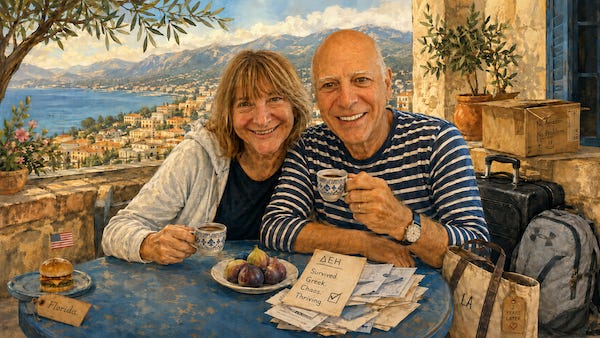
June 19, 2024.
Eleftherios Venizelos Airport.
Άφιξη αεροπορικής εταιρείας Δέλτα, πτήση 240 από Βοστώνη.
Arrival: Delta flight 240 from Boston.
The flight was packed.
Tourists arriving to experience Greece in the summer.
Greeks of the diaspora returning to reconnect with family, recover their Greekness, eat properly, argue lovingly, and spend some well-deserved vacation time under the sun.
And us.
The usual suspects were waiting outside arrivals.
Papou.
Yiayia.
An aunt with koulourakia.
A cousin holding flowers.
Someone waving too early.
Someone crying before the sliding doors even opened.
Not for us.
No committee.
No koulourakia.
No cousin with flowers.
No emotional Greek airport reunion with three generations blocking the exit.
Just Karen, me, and our luggage.
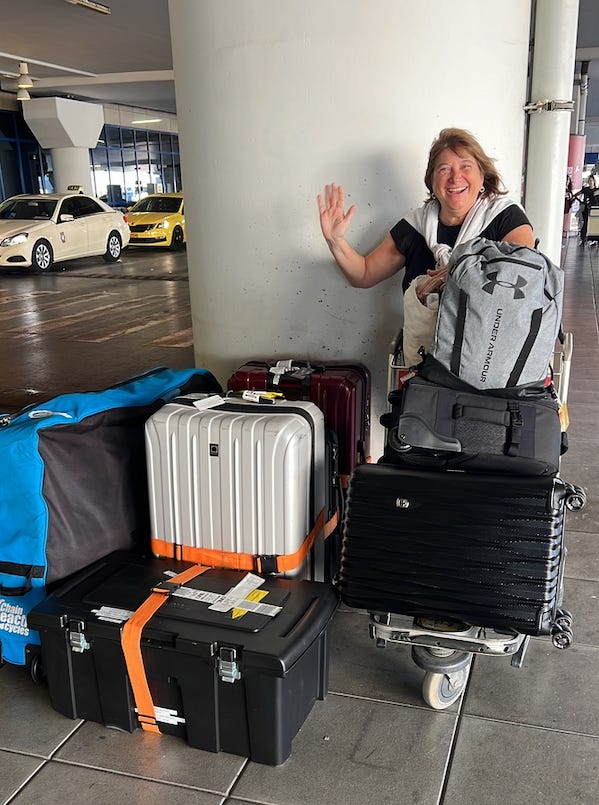
So much luggage.
Suitcases.
Bags.
My bike.
A few things we needed.
Many things we probably did not.
And the quiet understanding that this was not a vacation.
This was the rest of our life arriving on a baggage carousel.
My Greek brain shifted immediately into full operational mode.
Collect the bags.
Find the bike.
Count everything.
Count again because panic is also a system.
Find a station wagon taxi large enough to fit our belongings, our nerves, and whatever confidence we still had left.
Get to Spotawheel, where I had arranged to lease a used Renault Clio.
Would everything fit?
Of course it would.
We were in Europe.
Everything fits in small European cars because Europeans have been lying about luggage capacity for generations.
Besides, I had done my research.
This is what I told Karen.
This is what I told myself.
This is what a man says when he is standing at Athens airport with too many bags, one bicycle, one wife, and a plan that may have been assembled with optimism instead of measurements.
On June 18th, Karen and I had left Florida, the United States, and the life we had built there.
I keep wanting to say we “ditched” Florida.
It sounds better.
More dramatic.
Like we threw our keys into the Gulf of Mexico, saluted the last Publix rotisserie chicken, canceled Amazon Prime in a burst of courage, and boarded a plane to Greece with two suitcases, one dream, and a suspicious amount of prescription medication.
But “ditched” is not quite right.
We did not run away.
We did not storm out.
We did not leave because one morning we woke up and said, “That’s it. We are done with America. Bring us feta.”
The truth is quieter.
It was time.
Time to stop working a regular job.
Time to stop organizing life around someone else’s calendar.
Time to ask the question people avoid for years:
What do we want the rest of this to look like?
Neither of us is calling it retirement.
Retirement sounds like a folding chair, a television remote, and waiting for someone to ask how your knees are.
This is not that.
This is choosing life more deliberately.
Choosing what you want to do.
When.
With whom.
Why.
And sometimes choosing to do absolutely nothing because the sun is hitting the balcony correctly and the coffee is still warm.
That is not retirement.
That is strategy.
Choosing Greece was not simple.
Yes, I am Greek, which helped. I knew the language, the food, the history, the hand gestures, and the very important national law that no conversation is complete until at least three people have repeated the same thing from different angles.
But I had also lived for thirty years in the United States.
Thirty years.
I am seventy now — spoiler alert — which means nearly half my life was spent there.
America was not a place I passed through.
It was not a chapter I skimmed.
It was a life.
Miami, Stone Ridge, Los Angeles, Miami, Naples. Work. Family. Friends. Mortgages. Traffic. Appointments. Car insurance. Grocery stores the size of aircraft hangars. A thousand little routines that, without asking permission, become who you are.
Karen and I spent twenty-five of our years together there.
Good memories.
Bad memories.
Ordinary memories, which are often the strongest ones.
The grocery store you knew by muscle memory.
The doctor’s office where they handed you the same form every time, as if your birthday might have changed.
The road where you always hit the same red light.
The restaurant where you ordered the same thing so many times the server stopped asking.
You do not leave that without feeling it.
Karen, interestingly, had spent more of her early life outside the United States than inside it before she met me. Europe was not some exotic fantasy to her. She had lived abroad. She understood that changing countries is not a vacation with paperwork.
It is paperwork with occasional views.
So when Greece became the serious option, we did not let Google hand us the brochure and call it research.
We knew better.
The travel brochure always leaves things out.
It shows the sea, the whitewashed church, the blue chair, the little table with two glasses of wine.
It does not show the person at the electricity office saying, “You need another paper.”
It does not show Google Maps confidently sending you into a street designed for donkeys and spiritual growth.
And it definitely does not explain that in Greece, an address is not always an address.
Sometimes an address is a rumor.
Sometimes it is a suggestion.
Sometimes it is “near the bakery, but not the new bakery, the old bakery, before the road where the man with the dog used to live.”
And somehow, the package arrives.
Or it does not.
This was one of the first things we had to relearn.
In Florida, if you ordered something from Amazon, it arrived before you had fully committed emotionally to the purchase.
You clicked.
You blinked.
A man appeared at your door holding socks, printer paper, vitamins, a frying pan, and something you did not remember ordering but apparently needed urgently at 11:43 p.m.
In Greece, ordering something is more spiritual.
There is Skroutz, the Greek equivalent of Amazon, if Amazon had cousins, opinions, and a looser understanding of geography.
We love Skroutz now.
We really do.
But delivery here depends on many things.
The courier.
The weather.
The address.
Whether the driver believes your building exists.
Whether Google Maps agrees.
Whether your phone rings at the exact moment you are in the bathroom.
Whether the driver has decided that “I am downstairs” means you should immediately abandon whatever you are doing and run into the street like your house is on fire.
Still, we adjusted.
Humans are amazing.
You can take away same-day delivery and somehow they survive.
After two years in Greece, people sometimes ask if we miss our life in the United States.
I can only speak for myself.
Mostly, no.
That sounds harsher than I mean it.
I do not miss the rhythm of that life.
I do not miss the pressure.
I do not miss the constant noise of productivity.
I do not miss the feeling that time was always being sliced, measured, spent, wasted, optimized, and monetized.
But I do miss pieces of it.
I miss our sons.
Of course I do.
That is the hardest part. There is no clever Greek expression, no balcony view, no plate of grilled fish that fixes the distance from your children.
You carry that with you.
I miss friends.
I miss familiar roads.
I miss certain restaurants.
I miss the American talent for making things easy, fast, labeled, trackable, returnable, and available in twelve colors.
I miss a proper burger.
Greek food is wonderful, but sometimes a man wants a burger that requires both hands and a small legal waiver.
And yes, I sometimes miss the convenience.
Walking into a store and knowing exactly how the system works.
Ordering something and not needing to enter into a relationship with the courier.
Finding ten kinds of mustard because apparently America considers mustard a constitutional right.
But do I miss the whole life?
No.
Not really.
Here, life is not necessarily easier.
Let us not get carried away.
Greece is not a spa treatment.
Greece can test you before breakfast.
There are forms.
There are offices.
There are repairs that begin as one small repair and end with three men named Giorgos, one cousin, a bucket, and a sentence that begins, “The problem is…”
There are appointments that exist in theory.
There are sidewalks that suddenly end because apparently they lost interest.
There are drivers who treat stop signs as mere suggestions.
There are elevators that feel like confession booths with cables.
There are government websites that make you question your life choices and possibly your birth certificate.
And yet.
There is also the man at the market who remembers what fruit you like.
There is the woman at the bakery who knows Karen now and does not need me to translate.
There is the neighbor who tells you who had surgery, who is renovating upstairs, who went to Athens, who came back from Athens, and whose cousin’s daughter is marrying someone from Patras.
There is the sea.
There is Taygetos.
There is the sound of church bells, scooters, jackhammers, dogs, children, old men arguing about nothing and everything, and someone somewhere dragging a chair across tile.
There is the produce that changes every few weeks because it is local and not imported.
The first cherries.
The apricots.
The small melons.
The peaches I wait for like a man awaiting medical results.
There is coffee that lasts.
There are conversations that are not scheduled.
There are people who still ask, “Have you eaten?” and mean it as both hospitality and medical concern.
At first, everything here was effort.
The phone.
The bank.
The lease.
The tax number.
The residency paperwork.
The electricity bill, which in Greece is not a bill as much as an archaeological document.
The water.
The internet.
The doctor.
The pharmacy.
The mail.
Every errand required vocabulary, patience, and sometimes a second coffee afterward.
But slowly, Greece stopped being “the place we moved to” and became the place where we live.
That is a big difference.
At first you say, “Our apartment in Greece.”
Then one day you just say, “home.”
It happens quietly.
You stop converting every price.
You stop comparing every system.
You stop saying, “In America, they do it this way,” because nobody cares and also you are not in America.
You learn where to buy the good tomatoes.
You learn which bakery.
You learn which road not to take unless you enjoy reversing uphill while an old man watches with judgment.
You learn that “avrio” does not always mean tomorrow.
You learn that “siga, siga” is not laziness.
It is a survival mechanism.
This life has been a rollercoaster.
But not the shiny American rollercoaster with seat belts, warning signs, and a teenage employee named Tyler making sure the gate is locked.
This is a Greek rollercoaster.
The kind where someone’s uncle welded part of it in 1978, the instructions are missing, and everyone keeps saying, “Don’t worry, it’s fine.”
And somehow, it is.
There have been frustrations.
Many.
There have been days when I wanted to shake a building, a website, a courier, a government office, or the entire concept of Greek bureaucracy.
There have been days when the language I was born into betrayed me because apparently I knew the old Greek, the family Greek, the emotional Greek, but not always the Greek of forms, permits, passwords, and municipal categories.
There have been days when Karen looked at me with the expression of a woman who had followed her husband across the ocean and was now wondering if he had any actual plan beyond “It will be fine.”
To be fair, that was often the plan.
And yet the laughter came back.
That may be the biggest thing.
Not happiness exactly.
Happiness is too big and too polished a word.
Laughter is more useful.
Laughter survives bureaucracy.
Laughter survives the courier calling from the wrong village.
Laughter survives the plumber saying, “This is a little old,” about something installed in 1953.
Laughter survives the moment Karen realizes her Greek has improved enough to understand the problem but not enough to solve it.
And Greece gives you material every single day.
That has been one of the greatest surprises of this move.
I came back to Greece and started noticing things again.
Small things.
The way people talk with their hands.
The way every name connects to another name.
The way a simple errand turns into a story.
The way Greeks can turn a parking problem into a constitutional debate.
The way a fruit seller can give you weather analysis, health advice, and political commentary while weighing your watermelon.
The way chaos and warmth live side by side here, sometimes in the same sentence.
In the United States, life had become efficient.
Here, life became observable.
That difference gave me back something I did not know I had misplaced.
Attention.
The Greek word that means one thing in the dictionary and seventeen things in real life.
The neighbor.
The delivery man.
The chair dragged across tile.
The old woman who knows more about the building than the land registry.
The cat who has clearly filed paperwork to own the veranda.
This is Greece.
At least our version of it.
Not perfect.
Not romanticized.
Not the Greece of postcards and influencer captions.
The real one.
The one with beauty and dust.
Sea and paperwork.
Feta and frustration.
Sunsets and potholes.
Ancient history and a man smoking under a No Smoking sign.
We did not come here to become younger.
We did not come here to escape age, illness, responsibility, family, or the past.
Those things travel well.
They fit easily into luggage.
We came here to live differently with whatever time we have.
To choose more.
To notice more.
To laugh more.
To sit by the sea on an ordinary Tuesday and understand that ordinary Tuesdays are the point.
June 18th will mark two years since we left Florida.
Two years since the suitcases.
Two years since the strange mix of fear, relief, grief, excitement, exhaustion, and “What have we done?”
Two years since America became the place where I had spent nearly half my life, and Greece became the place where we decided to start again.
Now Greece is not the experiment anymore.
It is just life.
Our life.
Messy.
Funny.
Loud.
Beautiful.
Complicated.
Full of fig trees, bureaucracy, sea air, distance from our sons, new friends, old memories, and the occasional burger craving.
Do I miss America?
Sometimes.
Do I regret leaving?
No.
Not for me.
Not for us.
We did not ditch Florida.
We did not ditch the United States.
We did not ditch our old life.
We honored it by knowing when it was time to stop living it every day.
And then we came here.
We started again.
Siga, siga. 💙
Nick in Kalamata
Discussion
Pull up a chair. Add a memory, a correction, a laugh, or something the story brought to mind.
Oh Nick, although I haven't made the move to Greece for good, I have certainly " done a lot of time" there.
So I resonate so much with all your writings, all of which bring a knowing smile to my face.
Keep writing about your experiences. I love reading them ❤️
Fantastic piece Nick. Thank you for taking the time to write it and share it with us. Siga, Siga.
I’m 73, Greek American but have dual citizenship and constantly think of moving. I’m single and this frightens me thinking of moving at my age, alone. Nothing really keeps me in America (NJ), but the thought of conquering a new place by myself is not on my radar. I wish I could get over this fear. I loved reading your story. Congratulations on 2 years.
Nick, i have just read your story and laughed out loud a lot. I thoroughly enjoyed hearing about your journey getting there, and hope you will continue writing about your life over there.
Congratulations on your 2nd anniversary!
im from Chile i have been traveling and living in Greece and is definitely the best time ever! im so happy for you guys enjoy!!
Loved reading your piece Nick, it made me laugh out loud. I'm an Australian born Greek and having been to Greece many times, have often dreamed about moving there, for a period of time though. I absolutely admire your bravery to pack up and start all over. Keep enjoying yourselves.
Love your story. You're an inspiration, keep writing.
Nick, so enjoyed reading your piece and chuckling along the way as it brought back memories from family visits. We've (siblings) had many conversations of "making the move" but have yet to be brave enough. Keep writing and who knows........
Great piece, Nick. My dad was born outside Argostoli and moved to the states in 1948. I spent 10 days in Lassi this May and realized I need to go back as soon as I landed in Denver. Your reality is my dream. If only I could convince the love of my life.
Am 76 year old , born in Oz to greek parents.
A charming ,gutsy story.I visited when 56 years old after my 1st visit as a 15 year old wlth my 18 year old dahghter.
I recall mentiong this trjp to the breakfast manager one morning.
In typical greek with hand movements he said,
What took you so long MALAKA.
This is Greece.
Hi Nick! Totally enjoyed your story of your move. My husband is greek, lived in US for 47 years. We have traveled to Greece to visit family for many years. We retired and now partially living in Nafpaktos with my elderly father in law. Trying to make up for time missed? Left our kids and grandchildren in NJ, and all my friends, moved to Myrtle Beach, and spending 5 or 6 months in Greece. We have family and friends here too. I question everyday if we are doing the right thing. Miss my grandbabies, every day life with them, but remind myself how busy they are. Thank God for FaceTime! We live in two beautiful places, adding NJ in between, and living vacation life! The guilty feeling hopefully will subside. 😉
I love this piece so much. My Greek-born husband and I also made a deliberate choice to move to Greece recently (and because our adult daughter is in the US we plan to spend about 7-8 months in Greece and 4-5 months in the US annually.)
Your experience resonates with me so strongly — many similar experiences (although we have found a local restaurant that serves fabulous hamburgers). Thank you for sharing your experience about your move to Greece.
Hi Nick,
I have no affiliation to Greece apart from as a UK citizen who has visited for dozens of holidays over the last 40 years!
I found your story so inspiring and amusing at the same time!
My wife and I have a dream in that if we ever come into serious money that we will spend 3-4 months of the year in Greece.
I’m very envious of the life you have made for yourselves.
To use an anglicised English phrase I will raise a glass of ouzo to you both,”Aspro Pato!”
Ian,50,Liverpool,UK
Nick what a brilliantly real read! Thank you for sharing! Child of Greek immigrants here married to a child of Irish immigrants. We have been calculating and strategizing our move from the US (also Florida) for years now. We have the EU passports in hand, and have pinpointed a few places that make sense as landing spots. But life throws curveballs. Unbeknownst to me, in Greece you inherit wealth AND debt. An aunt passed years ago (no children) leaving me both but the debt possibly considerably outweighing the wealth. This has thrown the proverbial wrench into things as we negotiate the legal system, … siga, siga. We are hopeful it all works itself out and we are able to experience the journey to our new home in Greece. I look forward to reading more from you and following your life in Kalamata with Karen!
Dear Nick,
I just finished reading your wonderful article and I’m in tears… Tears of love, emotion, and longing.
Over 25 years ago, I caught the Crete bug, and after many trips, I’m finally able to spend at least all my days off in a rented cottage on the island of my heart.
Sometime in the next two years, I’ll also be trading my orderly Swiss life for the chaotic, free, and challenging Greek one.
I’m looking forward to it, because there will be something in everything that feels warm, genuine, and right.
Although I don’t have Greek roots, I don’t think I could be more myself anywhere else.
And I don’t mean that in an esoteric way—it’s simply a fact.
In any case, I look forward to reading more from you and wish you all the very best.