

Some people know Greek summer has arrived when they start thinking about the beach.
Crystal waters.
Tsipouro at the taverna.
Salt on the skin.
Sand in places sand has no business being.
The first swim.
The first sunburn.
The first loud discussion about whether the umbrella is “too close” to somebody else’s umbrella.
This is one version of Greek summer.
The brochure version.
The version with blue water, white houses, grilled octopus, and a woman in a linen dress walking slowly toward a boat she probably does not own.
Other people are more official about it.
They look at the calendar.
June 1st.
There it is.
Summer.
A date has spoken.
The calendar has declared it.
The nation may now proceed to sweat.
Others consult the thermometer, because Greeks are nothing if not dramatic about the υδράργυρος.
The mercury.
Once it hits 30 degrees, summer has apparently been certified by science, tradition, and every uncle who suddenly becomes a meteorologist.
“Thirty today,” he says.
Not as information.
As prophecy.
“By Friday, thirty-five.”
He pauses.
He looks toward the horizon.
“Bad things.”
No one knows what bad things.
Heat.
Dust.
Meltemi.
The end of civilization.
A slight discomfort near noon.
Greek weather commentary is never just weather commentary. It is philosophy with humidity.
But for me, summer arrives differently.
It arrives at the market.
Not all at once.
Greek summer does not enter the room politely.
It starts sending messengers.
First, the βλίτα (vlita) appear.
Piled high in green, leafy abundance.
There they are, sitting at the market like an announcement from the soil.
Βλίτα (vlita).
Summer weeds, basically.
But edible.
And somehow wonderful.
The first time I see them, I know we are getting close.
Then come the first mini melons.
Small, fragrant, promising.
The kind you pick up, sniff, tap, inspect, reconsider, put down, pick up again, and finally buy because an old man nearby is watching you and now you feel judged.
Then come the cherries.
The apricots.
The fruit starts glowing.
The market begins to smell like sugar, dust, leaves, and impatience.
And then the waiting begins.
Because summer is not just what appears.
Summer is what you know is coming.
Soon enough, the white peaches will arrive.
My favorite.
Not the hard ones that taste like furniture.
The good ones.
The soft, fragrant, dangerous ones.
The ones you cannot eat while driving unless you are prepared to arrive somewhere looking like you survived a fruit-related crime scene.
Then the grapes.
And finally, the sacred fruit of Greek summer.
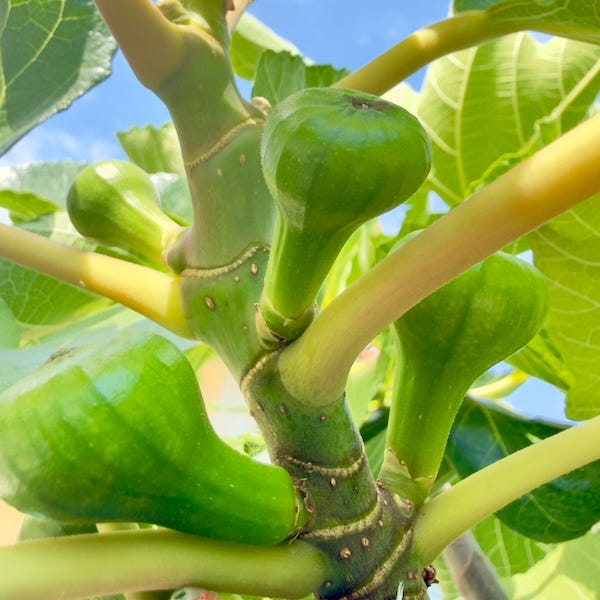
Figs.
My beloved figs.
The figs I monitor in a fifteen-kilometer radius from downtown Kalamata like I work for the Ministry of Fruit Readiness.
This is not theft.
This is research.
I prefer the term seasonal observation. My wife is calling it an obsession.
Some trees show more promise this year than others. You can tell.
A good fig tree has confidence.
It leans into the road slightly, as if it knows people are watching.
Its leaves are big.
Its branches are heavy.
It has the quiet arrogance of a tree that understands it will be discussed by strangers.
A bad fig tree looks tired.
Disappointed.
Like it has been through the municipality, three inheritance disputes, and a family lunch that went badly.
I have my eye on several.
I will not name their whereabouts.
That would be unprofessional.
Coming back from Methoni the other day, we could still see white patches on the top of Taygetos.
Snow.
Or at least what looked like snow.
Little scraps of winter still clinging to the mountain.
As if Taygetos was reminding us that this year’s weather has been strange.
“Yes, yes,” the mountain seemed to say. “Enjoy your cherries. I was still wearing winter last week.”
And that is Greece too.
You can be buying apricots in the morning, sweating by lunch, and looking at snow in the afternoon.
The country refuses to commit to a single season.
It prefers drama.
But there is another unmistakable sign of Greek summer.
Not the calendar.
Not the thermometer.
Not the fruit.
Noise.
Greek summer is not quiet.
Greek summer does not gently arrive.
Greek summer kicks open the door, drops a bag of tools on the floor, and starts yelling to someone named Takis.
First comes the construction noise.
Because apparently every repair in Greece must begin at 7:03 in the morning.
Not 7:00.
That would be too organized.
7:03.
The hour of destiny.
A drill wakes up.
A hammer joins.
Somewhere, a man drags a metal ladder across concrete with the emotional intensity of a composer writing his final symphony.
Then the dogs.
I had no idea dogs hibernate like bears.
All winter, silence.
Maybe one polite bark now and then.
A little neighborhood commentary.
Then June arrives and every dog in Kalamata remembers it has a voice, a mission, and several unresolved opinions.
One dog barks.
Another answers.
A third dog, three streets away, joins because democracy.
Soon there is a full canine parliament in session.
No agenda.
No minutes.
No conclusion.
Just barking.
A lot of barking.
Important barking.
Barking that says, “I have seen a leaf.”
Barking that says, “A scooter passed.”
Barking that says, “I am alive and everyone must know.”
Then come the children.
Laughing outside.
Playing.
Shouting.
Chasing balls.
Screaming like someone has discovered fire.
It is wonderful, of course.
Mostly.
Depending on the hour.
Depending on the coffee.
Depending on whether the ball has hit your balcony railing for the sixth time.
There is a particular Greek child-scream that does not necessarily mean danger.
This is important for foreigners to understand.
In many countries, a child screaming at full volume means someone should check.
In Greece, it may simply mean:
“I have a cousin.”
Or:
“The ball exists.”
Or:
“My brother looked at me.”
Or:
“Life is happening and I must report it to the entire neighborhood.”
Then come the scooters.
The chairs scraping.
The shutters opening.
The shutters closing.
The metal gates.
The delivery motorcycles.
The distant argument.
The near argument.
The man on the phone who believes phones still require shouting because perhaps the sound must physically travel through the air to Athens.
And then comes the true soundtrack of early Greek summer.
The sacred machine.
The municipal lullaby.
The sound that tells you bureaucracy has entered nature.
Brrrrrrrrrrrr.
Zzzzzzzhhhhhhhhh.
Brrrrrr.
Pause.
Zzzzzzzzzhhhhhhhhh.
The weed whacker.
All over Greece, men are now standing in fields, yards, lots, corners, forgotten family properties, abandoned dreams, and suspicious patches of land, attacking weeds with the urgency of people who have suddenly remembered that the government has a website.
Because June 15 is approaching.
And by then, you must confirm on the gov.gr platform that your plot has been cleared.
This is Greece at its finest.
Nature grows.
The state notices.
A platform appears.
A cousin calls.
A neighbor comments.
Someone says, “You know, there are fines.”
Someone else says, “I heard they check with satellites.”
Now everyone is an expert in vegetation compliance.
People who have ignored a plot of land since 1998 are suddenly speaking in serious tones about dry grass, fire risk, municipal responsibility, and whether that one corner near the wall counts as cleared.
“Did you declare it?”
“Did you clean it?”
“Did you take photos?”
“Did you upload?”
“Did you use the codes?”
There are always codes.
There is always a platform.
There is always one field where nobody knows who technically owns it because three cousins, one aunt, two brothers, and a man in Canada may still have a percentage.
But the weeds do not care about inheritance law.
The weeds grow.
The deadline approaches.
And the weed whackers sing.
This is the real opening ceremony of Greek summer.
Not the first swim.
Not the first beach towel.
Not the first taverna table by the sea.
It is the sound of a man in long pants, boots, sunglasses, and mild panic, cutting down dry grass while another man watches and offers advice.
“More to the left.”
“Careful near the wall.”
“You missed a spot.”
There is always a spot.
There will always be a spot.
Greece has survived wars, occupations, crises, governments, referendums, and family lunches.
But no Greek property has ever been fully cleared to the satisfaction of the man watching from across the road.
And somewhere in the middle of all this, summer officially begins.
The fruit says yes.
The thermometer says yes.
The dogs say yes.
The children say yes.
The construction workers say yes.
The weed whackers say:
BRRRRRR-ZZZZZHHHHHH.
Even Taygetos, with its little white patches still hanging on, seems to surrender.
Fine.
Summer.
Take it.
For me, Greek summer begins when the market turns sweet, the fig trees become worth monitoring, the mountain still refuses to fully let go of winter, and the entire country starts making noise as if silence itself has been declared illegal.
And somewhere, on gov.gr, a checkbox waits.
Summer has arrived. Καλο καλοκαιρι!
Siga, siga 💙
Nick in Kalamata
Discussion
Pull up a chair. Add a memory, a correction, a laugh, or something the story brought to mind.
No comments yet. We have been waiting for you...